What GMT Means on a Watch
A GMT watch is a watch that can show two time zones at once. The letters GMT stand for Greenwich Mean Time. That time standard was once based on the Royal Observatory in Greenwich, London. In everyday watch talk, GMT is now often used in the same way as UTC. UTC is the modern global time standard. You do not need to learn the full history to use one. That shared starting point is why the idea works all over the world.
On a normal watch, the hour hand shows the time where you are. On a GMT watch, you get one extra piece of information. It is a second time, shown at the same time, on the same dial. For example, you could be in London while also keeping track of the time in New York, Dubai, or Singapore. That second time is the whole point of the complication. Travellers often find a GMT watch useful. So do people who work across borders, and anyone with family or colleagues abroad.
Think of a GMT watch as a normal watch with a second job. It still tells the local time in the usual way. It simply adds a clear, separate way to read another time zone. You do not need mental maths or your phone.
How the GMT Hand and the 24-Hour Bezel Work
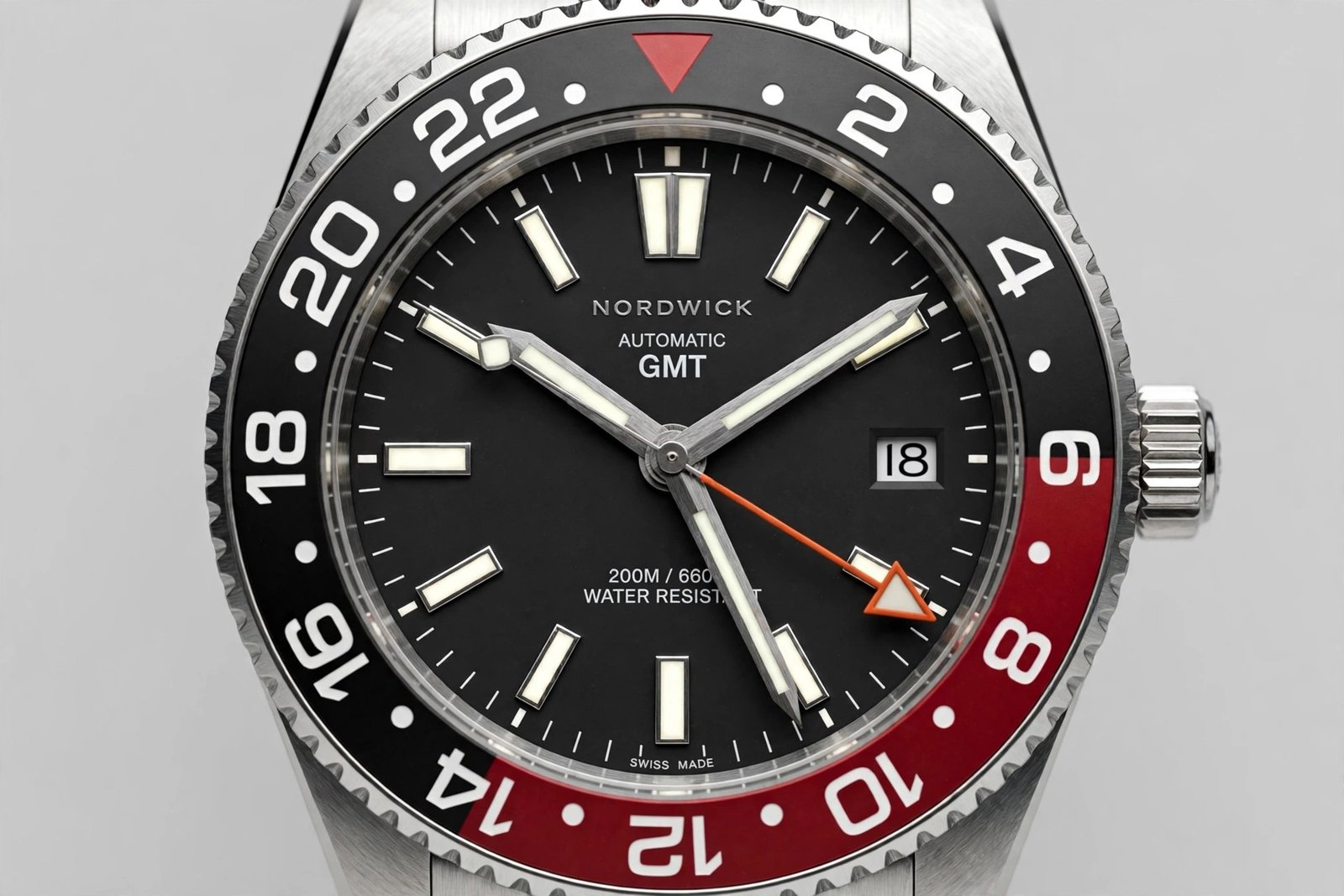
The key part of most GMT watches is an extra hand, often called the GMT hand. It is usually shaped differently from the normal hour and minute hands. For example, it may be an arrow or a triangle. That shape helps you spot it at a glance. The normal hour hand goes round the dial once every 12 hours. The GMT hand goes round once every 24 hours. That slower pace is important, because it lets you tell day from night in the second time zone.
Around the outside of many GMT watches, you will also see a bezel. It is marked with 24 hours, from 1 to 24. This is the 24-hour bezel. Together, the GMT hand and this bezel form a simple system. The GMT hand points to a number on the 24-hour scale. That number is the hour in the second time zone.
For example, if the GMT hand points to 14 on the bezel, the second time is 2 in the afternoon. If it points to 3, the second time zone is at 3 in the morning. Because the scale runs to 24, you do not have to guess whether it is day or night there. That is the main advantage over simply remembering that another city is five hours behind.
Some GMT watches have a fixed bezel, while others have one you can turn. A rotating bezel can line up a third time zone for a short period, although that reading is less direct. If you only need two zones, a fixed bezel is simpler.
How to Set and Read a Second Time Zone
Setting a GMT watch sounds more complex than it is. The basic steps are the same in principle across most models. First, set the normal time to your local time, just as you would with any watch. Second, set the GMT hand to the time in the second zone you want to follow. Third, check the result against a reliable time source, such as your phone. Do this before you rely on it for a call or a flight.
Reading it is then straightforward. Look at the normal hands for local time. Then look at the GMT hand against the 24-hour bezel for the second time. If you travel, you can change the local time while leaving the GMT hand where it is. Your home time stays visible. If you move to a new base, you can reset the GMT hand to a new second zone instead.
A common mistake is to mix up the two hands when you first start using the watch. To avoid this, take a moment to learn the shape and colour of the GMT hand on your own watch. Check it in good light at first. Another useful habit is to set the second zone to a place you contact often. Do not change it every day. That way, the reading becomes familiar, and you are less likely to misread it when you are in a hurry.
Remember that a few places use half-hour differences. A GMT watch shows hours clearly. You will need to allow for that extra half hour yourself if your second zone is one of them.
Traveller Use Versus Office Use
Travellers were the first obvious users of GMT watches, and they still benefit the most. When you land in a new city, your local time changes, but your home time does not disappear. With a GMT watch, you can see both at once. That helps you decide whether it is a reasonable hour to call home. It also helps you decide whether a message can wait until morning. You can also check when a meeting back home is due to start.
Office use is different, but just as practical. If you work with colleagues, clients, or suppliers in another country, a GMT watch is practical. It keeps that second zone in front of you all day. For example, if your team is split between the UK and another region, you can see at a glance whether a colleague is likely to be at their desk. You can also tell whether they are at lunch, or finished for the day. That can help you time emails and calls more politely. It can also reduce the number of messages sent outside working hours.
In short, travellers use a GMT watch to stay connected to home while they move. Office users use it to stay connected to another place while they stay put. The watch itself does not change. Only the reason for watching the second time changes.
GMT Versus Dual-Time Versus World-Time, in Plain Terms
You may also see watches described as dual-time or world-time watches. It helps to know how they differ from a GMT watch. The terms are sometimes used loosely, but in plain terms they point to different levels of detail. For a broader overview, see Types of Watches: Complete Guide.
A dual-time watch, like a GMT watch, shows two time zones. The difference is mainly in how the second time is shown. Some dual-time watches use a small sub-dial for the second time, rather than a GMT hand and a 24-hour bezel. Others use a second hour hand in a simpler form. For everyday use, the result is similar: local time plus one other time. A GMT watch is, in effect, one popular way of doing dual-time, with the 24-hour reading as its defining feature.
A world-time watch goes further. Instead of one second zone, it aims to show many zones at once. City names are often printed around the dial or on a rotating ring. That can be useful if you deal with many regions in one day, but it is also busier to read. For most people, a world-time display gives more information than they need. The extra detail can make the dial harder to read at a glance.
What to Check Before Choosing One
Before you choose a GMT watch, start with readability. Can you tell the GMT hand apart from the other hands quickly, in normal light and in low light? Is the 24-hour bezel clear, or does it blend into the dial? A GMT watch that is hard to read defeats its own purpose, however attractive it looks in a photo.
Next, think about how you will set it. Some GMT watches let you adjust the local hour hand independently, which is very helpful when you travel. Others require a different sequence of adjustments. Neither approach is wrong, but the one that feels natural to you will be the one you actually use correctly. If you can, try the setting process in a shop or read the instructions carefully before you decide.
You should also think about size and comfort. A GMT watch often has a slightly busier dial than a simple three-hand watch. A clear layout matters more than usual. The watch should also feel comfortable for all-day wear. A second time zone is only useful if the watch is actually on your wrist.
Finally, think about care in general terms. Like any watch, a GMT watch needs regular care, and its extra hand adds one more part to the movement. Follow the maker’s care guidance and have the watch checked when it is due.
FAQs
What does GMT stand for on a watch?
GMT stands for Greenwich Mean Time. On a watch, it means the watch can show a second time zone. It is based on that shared time standard, alongside your local time.
Do I need a GMT watch if I do not travel?
Not necessarily, but you may still find one useful. If you regularly contact people in another time zone for work, study, or family reasons, a GMT watch helps. It keeps that second time visible without checking your phone.
Is a GMT watch the same as a dual-time watch?
In everyday use, the two ideas overlap. A GMT watch is one type of dual-time watch. It has a GMT hand and a 24-hour bezel as its main features. Some dual-time watches show the second time in a different way, such as on a small sub-dial.
How do I know whether it is day or night in the second time zone?
Use the 24-hour bezel. Because the GMT hand moves round once every 24 hours, a reading of 14 means 2 in the afternoon. A reading of 3 means 3 in the morning. That day-and-night difference is the main benefit of the 24-hour scale.
Does a GMT watch adjust itself for daylight saving time?
No, not on its own. When local clocks change for daylight saving, you will need to adjust the relevant hand yourself. The same applies when the second zone changes its own rules. It is worth checking the time again after any clock change.
A Simple Way to Decide
A GMT watch earns its place when you follow one other time zone often. Checking it then becomes part of your day. It does not need to be complex to be useful. A clear GMT hand, a readable 24-hour bezel, and a setting method you understand matter most. They are more important than extra features you will rarely use.
If that sounds like your routine, a GMT watch can make the second time feel natural. This applies whether you travel often or work across borders from one desk. Start with readability. Set it to the place you contact most. Let the second hand do the quiet work in the background.