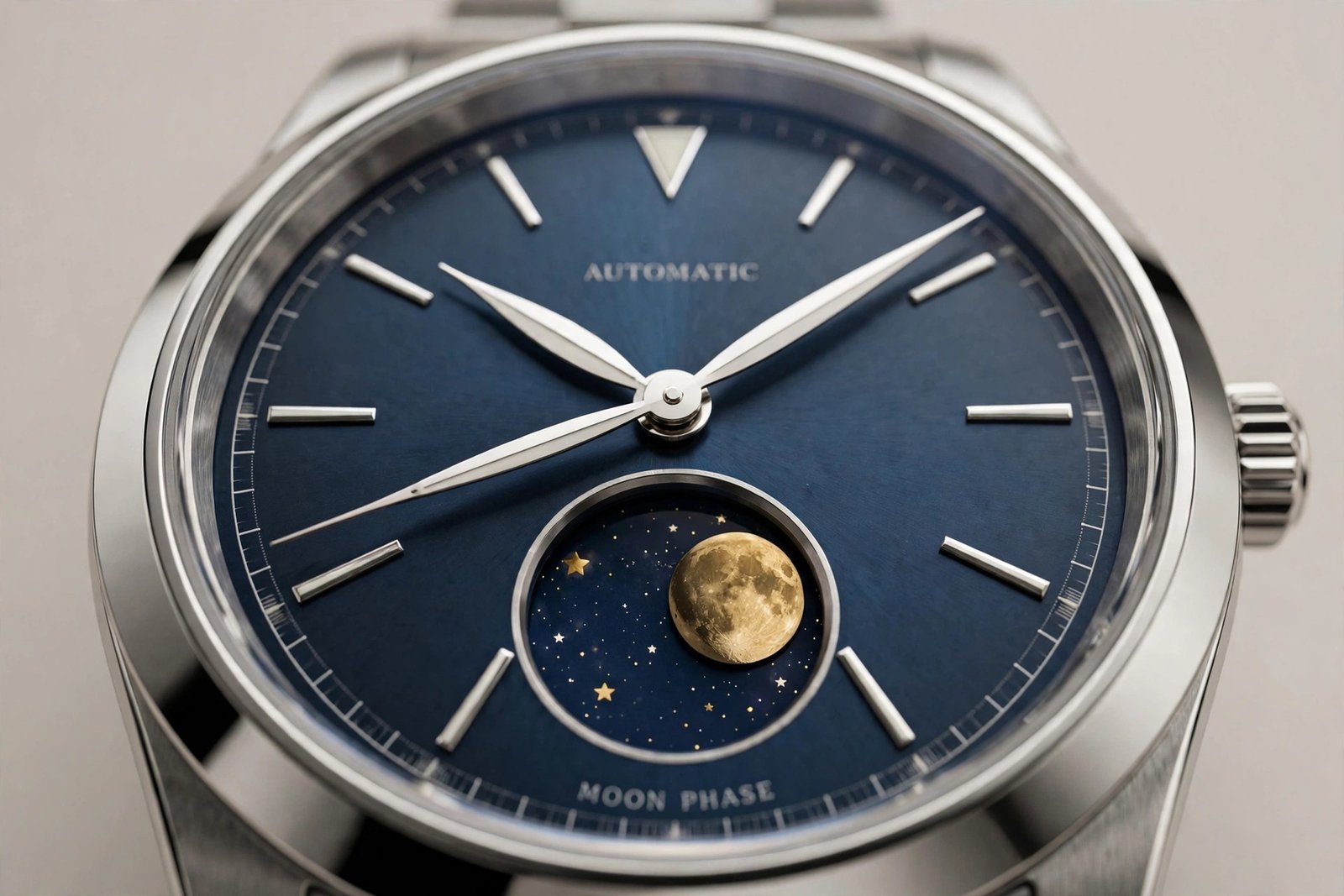
Watches with a moon phase do one beautiful, simple thing. They show you where the Moon is in its monthly cycle, right there on the dial. Instead of a plain date window, you get a small aperture. It is usually at six o’clock, with a rotating disc underneath it. As the days pass, a painted moon glides across a starry sky. It moves from new moon to full moon and back again.
You may see the same idea described in several different ways. A lunar cycle watch, a moonphase watch, a moon cycle watch, or a watch with phases of the moon all point to the same complication. The wording may differ on the dial or in a shop listing. A moon phase wrist watch is simply a wristwatch fitted with that display. This guide to watches with a moon phase explains how they work and how accurate they really are. It also covers what to check before you choose one. That way, you can enjoy the complication without being caught out by its quirks.
What a moon-phase complication actually shows — and what it does not show
A moon-phase display tracks the age of the Moon, not the time of day, the date, or the weather. The lunar cycle lasts about 29.5 days, from one new moon to the next. The display moves in step with that cycle. You can tell at a glance whether the Moon is waxing, full, or waning.
It does not show the exact position of the Moon in the sky. It does not tell you when the Moon will rise or set where you live. Think of it as a poetic calendar for the Moon, rather than an astronomical instrument. If you want precise moonrise times for a particular town, you will still need a dedicated almanac or app. What a moon-phase watch gives you is a daily, visible reminder of the cycle. It is built into something you already wear.
It is also worth knowing that most moon-phase watches show the phase for the northern hemisphere. If you travel south of the equator, the image in the aperture will look upside down. That is despite the timing of the cycle being the same.
How it works: the 29.5-day lunar cycle, gearing, and accuracy drift
At the heart of watches with a moon phase is a disc carrying two painted moons, one on each side. The disc turns very slowly, driven by the movement through a set of gears. Each day, the disc advances by a small step. The aperture then reveals a little more, or a little less, of the moon.
The classic arrangement uses a gear with 59 teeth. Because the disc carries two moons, each tooth moves the display by half a lunar cycle. That works out at 29.5 days per full cycle. That is a neat mechanical shortcut. It is why the complication has been popular for so long. It is simple, reliable, and easy to read.
The catch is that the true lunar cycle is about 29.53 days, not exactly 29.5. The tiny difference adds up. On standard watches with a moon phase, the display will drift by roughly a day every two to three years. In everyday use, that is easy to live with. You may not even notice it for a long time. When you do, a quick reset puts it right again. It is a charming imperfection, rather than a fault, and it is part of why collectors enjoy the complication.
Standard vs astronomical moon phases
If accuracy matters more to you than simplicity, look out for the term astronomical moon phase. These versions use finer gearing, so the display tracks the true lunar cycle far more closely. A standard moon phase may drift by a day in a couple of years. An astronomical version stays accurate far longer. It is often described as staying accurate for well over a century. In some cases, it may last more than a hundred years before it would need a one-day correction.
That does not make a standard moon phase a poor choice. For most wearers, a display that needs a small reset every few years is perfectly fine. The simpler mechanism is easier to service. An astronomical moon phase is a talking point. It is also a showcase of careful engineering. It is not essential if you simply enjoy watching the Moon change. Choose the standard version for charm and simplicity. Pick the astronomical version if long-term precision is part of the appeal for you.
How to set a moon phase correctly — and the common mistake to avoid
Setting a moon phase is straightforward once you know the current age of the Moon. That first step is where most people go wrong. Do not guess. Check a reliable moon-age reference for today, then set the display to match it. If you set it from a random date, the display will look right for a day or two. It will then quietly drift out of step, and you will have to start again.
The second common mistake is forcing the mechanism. Most moon-phase watches are advanced with the crown or a small pusher, and they are designed to move forward only. Never force a pusher if it resists, and do not try to wind the display backwards. If you are unsure which crown position or pusher controls the moon phase, check the instructions for that watch. Do this before you start. A few minutes spent reading them is far better than a repair bill.
A useful routine is to set the moon phase at the same time as you set the date. Do this after the watch has been running for a while. That way, you are less likely to change one display and forget the other. The watch is already in its normal running state when you make the adjustment.
Who a moon-phase watch suits — and who should skip it
Watches with a moon phase suit you if you enjoy a watch with a story. You will like glancing down to see something more than the time. The display adds visual interest to a dial without making the watch hard to read. It also gives you a gentle connection to the natural cycle outside. It also suits anyone who likes traditional watchmaking, because the complication has been made in various forms for centuries.
You may want to skip it if you prefer a watch you can set once and forget. The same applies if you wear several watches in rotation. A moon-phase watch that sits unworn for weeks will need a reset when you pick it up again. This covers its time, date, and moon phase, just like any calendar watch. If that sounds like a chore rather than a pleasure, a simpler dial may suit you better. The same applies if you need a watch for rough, everyday work. A moon-phase aperture is a beautiful detail, not a tool for hard use. It deserves a little care.
What to check before choosing one
Before you choose, check readability first. Look at the aperture in normal light, not just in a bright shop window. Is the moon easy to see against the starry disc? Is the aperture large enough to read at a glance, or is it so small that you need to squint? A moon-phase display should be a pleasure to look at, not a puzzle.
Next, check how it is set. Is there a dedicated pusher, a crown position, or a recessed corrector that needs a small tool? Make sure you are comfortable with that method, and that you can reach it without fumbling. Also ask how the watch is serviced. Like any mechanical complication, a moon-phase movement benefits from regular servicing by someone who understands it. Factor that into your long-term thinking, rather than treating it as an afterthought.
Finally, consider the overall watch, not just the aperture. Does the case size suit your wrist? Check the strap for how you will wear it. Also check that the dial stays readable when the moon phase is at its darkest, during a new moon. Good watches with a moon phase should work as watches first. The lunar display should be a bonus, not the other way round.
Caring for watches with a moon phase day to day
Day-to-day care is mostly common sense. Keep the watch away from strong magnets and avoid sharp knocks. Store it somewhere dry and safe when you are not wearing it. If it is a mechanical watch, wind it regularly. Wear it often enough to keep it running, so the moon-phase display stays in step.
If the watch stops, reset the time and date first, then the moon phase, using a current moon-age reference. Do not leave a stopped moon-phase watch for months. Do not then expect it to be right when you pick it up again. A short, regular routine will keep it accurate and enjoyable. It will also help you notice any change in how the watch runs. That way, you can have it checked sooner rather than later.
FAQs
How accurate is a moon phase?
A standard moon phase is accurate enough for everyday enjoyment. Its drift is roughly a day every two to three years. An astronomical moon phase is far more precise, and may not need a correction for well over a century. Neither version is meant to replace a dedicated astronomical reference.
Does a moon-phase watch need resetting?
Yes, from time to time. If the watch stops, or if a standard display has drifted, you will need to reset it. Use the current age of the Moon. That is normal for this complication, and it is a quick job once you know the method for your watch.
Is a lunar cycle watch the same as a moon-phase watch?
Yes. A lunar cycle watch, a moon cycle watch, and a watch with phases of the moon are different names for the same idea. They describe a display that tracks the roughly 29.5-day cycle from new moon to full moon and back again. The wording may change, but the complication does not.
Is a moon-phase watch hard to live with?
Not if you enjoy it. The main demands are setting it correctly in the first place. They also include resetting it after a long break and giving it normal mechanical care. If you like the look of the moon gliding across the dial, those small routines are part of the pleasure. They are not a burden.